

Global Value-Based Healthcare Market is Predicted to Cross USD 60 Billion by 2034 | DelveInsight
The value-based healthcare market is witnessing robust growth as healthcare systems worldwide shift from traditional fee-for-service models toward payment and care delivery approaches that prioritize patient outcomes, quality, and cost efficiency. Rising healthcare expenditure, the growing burden of chronic diseases, increasing demand for patient-centric care, and the need to reduce avoidable hospitalizations are encouraging payers and providers to adopt value-based models. In addition, government initiatives and reimbursement reforms are accelerating the transition toward accountable care, shared savings, bundled payments, and risk-based arrangements.
New York, USA, Sept. 16, 2026 (GLOBE NEWSWIRE) -- Global Value-Based Healthcare Market is Predicted to Cross USD 60 Billion by 2034 | DelveInsight
The value-based healthcare market is witnessing robust growth as healthcare systems worldwide shift from traditional fee-for-service models toward payment and care delivery approaches that prioritize patient outcomes, quality, and cost efficiency. Rising healthcare expenditure, the growing burden of chronic diseases, increasing demand for patient-centric care, and the need to reduce avoidable hospitalizations are encouraging payers and providers to adopt value-based models. In addition, government initiatives and reimbursement reforms are accelerating the transition toward accountable care, shared savings, bundled payments, and risk-based arrangements.
DelveInsight’s Value-Based Healthcare Market Insights report provides the current and forecast market analysis, individual leading value-based healthcare companies’ market shares, challenges, value-based healthcare market drivers, barriers, trends, and key value-based healthcare companies in the market.
Value-Based Healthcare Market Summary
- 2025 Value-Based Healthcare Market Size: USD 16.5 Billion
- 2034 Projected Value-Based Healthcare Market Size: USD 62 Billion
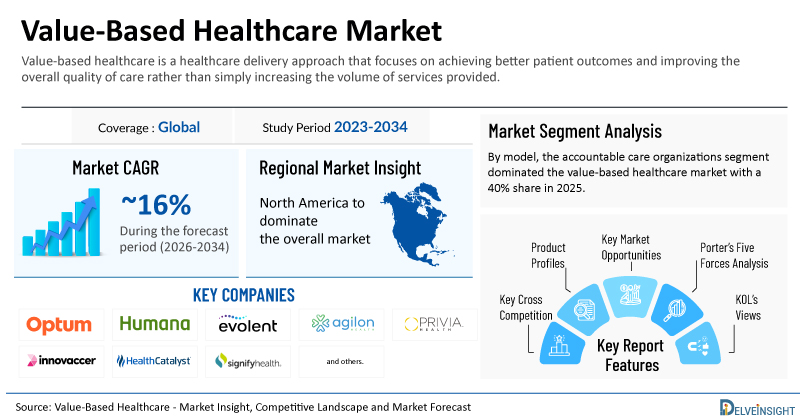
- Value-Based Healthcare Market Growth Rate (2026-2034): ~16%
- Largest Value-Based Healthcare Market: North America
- Largest Model Segment: Accountable Care Organizations Category
- Key Companies in the Value-Based Healthcare Market: Optum, Inc., Humana Inc., Evolent Health, Inc., Agilon Health, Inc., and Privia Health Group, Inc., alongside Aledade, Inc., Innovaccer Inc., Health Catalyst, Inc., Signify Health, Inc., and Arcadia Solutions, LLC. Additional participants, including Pearl Health, Inc., Astrana Health, Inc., Lumeris, Inc., Vytalize Health, Inc., and others
To read more about the strategies to implement value-based healthcare, get a snapshot @ https://www.delveinsight.com/report-store/value-based-healthcare-market
Key Factors Contributing to the Rise in Growth of the Value-Based Healthcare Market
- Growing Focus on Patient Outcomes: Healthcare providers and payers are increasingly prioritizing treatment outcomes, quality of care, and patient satisfaction rather than the volume of services delivered. This shift is encouraging the adoption of value-based care models that link reimbursement to measurable health outcomes.
- Rising Healthcare Costs: The continuous increase in healthcare expenditure is prompting governments, insurers, and healthcare organizations to seek more cost-efficient care delivery models. Value-based healthcare helps reduce unnecessary procedures, hospital readmissions, and avoidable expenses while improving overall care quality.
- Increasing Adoption of Digital Health Technologies: The growing use of electronic health records, remote patient monitoring, artificial intelligence, and data analytics is enabling providers to track patient outcomes more effectively. These technologies support real-time decision-making, personalized treatment, and performance-based reimbursement.
- Government Support and Reimbursement Reforms: Governments and healthcare authorities are increasingly introducing policies that encourage outcome-based reimbursement and coordinated care. Such reforms are accelerating the transition from traditional fee-for-service models toward payment structures that reward quality, efficiency, and improved patient outcomes.
- Rising Prevalence of Chronic Diseases: The increasing burden of chronic conditions such as diabetes, cardiovascular diseases, cancer, and respiratory disorders is creating demand for long-term, coordinated disease management. Value-based models can improve continuity of care while helping providers manage chronic disease costs more effectively.
- Increasing Demand for Personalized Healthcare: Patients are increasingly seeking personalized treatment approaches that address their specific clinical needs and improve health outcomes. Value-based healthcare supports individualized care plans by leveraging patient data, clinical insights, and outcome measurements.
- Growing Emphasis on Preventive Care: Healthcare systems are placing greater emphasis on disease prevention, early diagnosis, and proactive patient management to reduce the need for costly interventions. Value-based care models incentivize providers to focus on prevention and maintaining long-term patient health.
- Expansion of Health Insurance Coverage: The expansion of public and private health insurance coverage is supporting the adoption of alternative reimbursement models. Insurers are increasingly collaborating with healthcare providers through value-based contracts to control costs while improving quality and patient outcomes.
- Increasing Healthcare Provider and Payer Collaboration: Greater collaboration among hospitals, physicians, insurers, pharmaceutical companies, and technology providers is facilitating the development of integrated care models. These partnerships enable better coordination of services, data sharing, and accountability for patient outcomes.
- Growing Use of Data Analytics and Outcome Measurement: Advanced analytics are allowing healthcare organizations to evaluate treatment effectiveness, identify high-risk patients, and measure clinical and financial performance. Improved access to actionable healthcare data is strengthening the implementation and scalability of value-based care programs.
Get a sneak peek at the value-based healthcare market dynamics @ Value-Based Healthcare Model
Regional Value-Based Healthcare Market Insights
North America
- North America dominated the global value-based healthcare market in 2025, capturing approximately 72% of the overall market value and representing the largest regional share worldwide.
- This strong market position is primarily attributed to the United States, which has played a leading role in advancing and implementing value-based care models.
- Key factors include the Centers for Medicare & Medicaid Services’ focus on accountable care, the presence of major healthcare technology and enablement companies, and the extensive scale of the U.S. healthcare system.
- The United States remains the largest national market, driven by the increasing transition of Medicare, Medicaid, and commercial insurers toward value-based reimbursement models.
- The expansion of initiatives such as the Medicare Shared Savings Program and models developed by the Center for Medicare & Medicaid Innovation has further accelerated adoption.
- In addition, a well-established ecosystem of physician enablement, population health management, and payer-aligned technology companies supports healthcare organizations in implementing value-based care strategies.
- The continued push by the Centers for Medicare & Medicaid Services to place all Traditional Medicare beneficiaries in accountable care relationships by 2030 is expected to further strengthen market development.
- With approximately half of Traditional Medicare beneficiaries already receiving care through accountable care organizations, the adoption of value-based models continues to expand.
- The broad penetration of value-based arrangements across Medicare, Medicaid, and commercial healthcare markets, combined with the concentration of enabling organizations and technology providers in the United States, reinforces North America’s market leadership.
- These factors are expected to sustain the region’s position as the largest value-based healthcare market throughout the forecast period.
Europe
- Europe is emerging as a significant market for value-based healthcare, supported by growing efforts to improve patient outcomes, enhance healthcare efficiency, and optimize resource utilization amid rising healthcare costs and increasing chronic disease burden.
- European healthcare systems are progressively shifting from volume-driven models toward outcome-focused approaches that emphasize patient-reported outcomes, quality of care, integrated care pathways, and cost-effectiveness.
- Countries such as Germany, the Netherlands, Spain, Italy, and the UK have undertaken various VBHC initiatives, including outcomes measurement, integrated care models, and outcome-based reimbursement mechanisms.
- The Netherlands has demonstrated notable progress through nationwide outcome and cost measurement initiatives, while Spain, Germany, and other European countries have implemented patient-centered and condition-specific models of care.
- The adoption of digital health technologies, electronic health records, patient-generated health data, and standardized outcomes measurement is further creating opportunities for VBHC implementation across the region.
- However, fragmented healthcare delivery, differences in reimbursement structures, limited standardization of outcome measures, and challenges in collecting and integrating healthcare data continue to constrain market development.
- Nevertheless, increasing policy emphasis on sustainable healthcare systems and evidence-based resource allocation is expected to strengthen the adoption of value-based care models across Europe.
Asia-Pacific
- Asia-Pacific is expected to record the fastest CAGR through 2034, driven by the growing shift toward value-based and outcomes-focused healthcare models.
- Governments and healthcare systems across the region are increasingly seeking to contain rising costs while improving care quality and outcomes for large patient populations, supporting the early adoption of value-based healthcare.
- China, Japan, and India represent the key national markets, supported by healthcare payment reforms, cost-containment initiatives, expanding health insurance coverage, and the increasing use of quality- and outcomes-based approaches.
- An aging population, the growing prevalence of chronic diseases, and mounting pressure on healthcare budgets are encouraging governments and payers to explore value-based payment models and population health management to enhance healthcare efficiency and outcomes.
- At the same time, rapid healthcare digitization, expanding health data, and advances in analytics are strengthening the infrastructure needed to support value-based care.
- As payment systems evolve, insurers increasingly embrace value-oriented models, and providers develop population health management capabilities, adoption is expected to accelerate from a relatively low base.
- This convergence of cost pressures, payment reforms, insurance expansion, and digital transformation is positioning Asia-Pacific as the fastest-growing regional market and increasing opportunities for global healthcare technology providers and value-based care enablers.
To know more about why North America is leading the market growth in the value-based healthcare market, get a snapshot of the Value-Based Healthcare Examples
Recent Developmental Activities in the Value-Based Healthcare Market
- In September 2025, Privia Health Group, Inc. agreed to acquire an accountable care organization business from Evolent Health, adding 120,000 attributed lives and bringing its total to 1.5 million attributed lives in value-based arrangements, for a payment of 100 million dollars at closing and a performance-based amount tied to Medicare Shared Savings Program results.
- In May 2025, the Centers for Medicare and Medicaid Services published a new strategic direction for its Innovation Center, emphasizing prevention, consumer engagement, technology-enabled care, and financial performance in the next phase of value-based payment reform.
- In 2025, the Centers for Medicare and Medicaid Services approved 228 applications for the Medicare Shared Savings Program, including 55 new and 173 renewing or reentering accountable care organizations, bringing the program to 476 accountable care organizations serving 11.2 million people with Traditional Medicare for the 2025 performance year.
What is Value-Based Healthcare?
Value-based healthcare is a healthcare delivery approach that focuses on achieving better patient outcomes and improving the overall quality of care rather than simply increasing the volume of services provided. Under this model, healthcare providers are incentivized based on the health outcomes, patient experience, safety, and efficiency of care they deliver, rather than the number of consultations, procedures, or treatments performed. Value-based healthcare aims to align the interests of patients, providers, and payers by promoting preventive care, early diagnosis, coordinated treatment, and cost-effective interventions. By emphasizing measurable outcomes and continuous improvement, the model can help reduce unnecessary healthcare spending while enhancing patient satisfaction and supporting better long-term health outcomes.
| Value-Based Healthcare Market Report Metrics | Details |
| Coverage | Global |
| Study Period | 2023–2034 |
| Value-Based Healthcare Market CAGR | ~16% |
| Value-Based Healthcare Market Size by 2034 | USD 62 Billion |
| Key Value-Based Healthcare Companies | Optum, Inc., Humana Inc., Evolent Health, Inc., Agilon Health, Inc., and Privia Health Group, Inc., alongside Aledade, Inc., Innovaccer Inc., Health Catalyst, Inc., Signify Health, Inc., and Arcadia Solutions, LLC. Additional participants, including Pearl Health, Inc., Astrana Health, Inc., Lumeris, Inc., Vytalize Health, Inc., and others |
Value-Based Healthcare Market Assessment
-
Value-Based Healthcare Market Segmentation
- Value-Based Healthcare Market Segmentation By Model: Accountable Care Organization, Pay for Performance, Bundled Payments, Capitation, and Patient Centered Medical Homes
- Value-Based Healthcare Market Segmentation By Component: Services and Software, and Platforms
- Value-Based Healthcare Market Segmentation By Application: Population Health Management, Care Coordination and Management, Risk Adjustment and Stratification, Quality Reporting and Analytics, and others
- Value-Based Healthcare Market Segmentation By End Users: Healthcare Providers, Payers, Employers, and Government, and others
- Value-Based Healthcare Market Segmentation By Geography: North America, Europe, Asia-Pacific, and Rest of World
- Porter’s Five Forces Analysis, Product Profiles, Case Studies, KOL’s Views, Analyst’s View
Which MedTech key players in the value-based healthcare market are set to emerge as the trendsetter explore @ Value-Based Healthcare Market Analysis
Table of Contents
| 1 | Value-Based Healthcare Market Report Introduction |
| 2 | Value-Based Healthcare Market Executive Summary |
| 3 | Value-Based Healthcare Market Key Factors Analysis |
| 4 | Impact Analysis |
| 5 | Regulatory Analysis |
| 6 | Value-Based Healthcare Market Porter’s Five Forces Analysis |
| 7 | Value-Based Healthcare Market Assessment |
| 8 | Competitive Landscape |
| 9 | Startup Funding & Investment Trends |
| 10 | Value-Based Healthcare Market Company and Product Profiles |
| 11 | KOL Views |
| 12 | Project Approach |
| 13 | About DelveInsight |
| 14 | Disclaimer & Contact Us |
Interested in knowing the value-based healthcare market share by 2034? Click to get a snapshot of the Top Value-Based Healthcare
Related Reports
Home Healthcare Market Insight, Competitive Landscape, and Market Forecast – 2034 report delivers an in-depth understanding of market trends, market drivers, market barriers, and key home healthcare companies such as Pfizer Inc. (BioNTech), Moderna, Dynavax Technologies, Alnylam Pharmaceuticals, Biogen, Ionis Pharmaceuticals, Sarepta Therapeutics, Nippon Shinyaku, Novartis, Bausch + Lomb, Gennova Biopharmaceuticals, DAIICHI SANKYO COMPANY, LIMITED, Arcturus Therapeutics, Inc., Biogen, NS Pharma, Inc., Eyetech Pharmaceuticals, and others.
AI in Healthcare Market Insight, Competitive Landscape, and Market Forecast – 2034 report delivers an in-depth understanding of market trends, market drivers, market barriers, and key AI in healthcare companies such as NVIDIA, Google (Alphabet), Microsoft, Amazon (AWS), Intel Corporation, Siemens Healthineers, GE HealthCare, Koninklijke Philips N.V., Aidoc, Viz.ai, Inc, Qure.ai, Recursion, Insilico Medicine, Abridge AI, Inc., Waystar, IBM, CitiusTech Inc, Tempus AI, Inc., Hippocratic AI, Solventum, and others.
AI in Remote Patient Monitoring Market
AI in Remote Patient Monitoring Market Insights, Competitive Landscape, and Market Forecast – 2034 report deliver an in-depth understanding of the market trends, market drivers, market barriers, and key AI in remote patient monitoring companies, including Medtronic, iRhythm Inc., Koninklijke Philips N.V., Siemens Healthineers, GE HealthCare, Apple Inc., AliveCor Inc., Biofourmis, Optum, Inc., Headspace Health, Withings, NeuroRPM Inc., Caretaker Medical, Implicity, Stryker, Biobeat, and others.
Healthcare Asset Management Market
Healthcare Asset Management Market Insights, Competitive Landscape, and Market Forecast – 2034 report deliver an in-depth understanding of the market trends, market drivers, market barriers, and key healthcare asset management companies, including CenTrak, Inc., GE HealthCare, IBM, Sonitor Technologies, Zebra Technologies Corp., Siemens, Securitas Healthcare LLC, Infor, Tyco Security Products, AiRISTA, Ekahau, Inc., PcsInfinity Private Limited, Novanta Inc., Oracle, Midmark Corporation, Qualer, Honeywell International Inc., Impinj, Inc., HP Development Company, L.P, Koninklijke Philips N.V., and others.
Healthcare Analytics Market Insights, Competitive Landscape, and Market Forecast – 2034 report deliver an in-depth understanding of the market trends, market drivers, market barriers, and key healthcare analytics companies, including IBM Corporation, Oracle Health, SAS Institute, Optum, McKesson Corporation, IQVIA, Epic Systems, Allscripts, Inovalon, Arcadia, Microsoft, Koninklijke Philips N.V., GE Healthcare, Tableau, MedeAnalytics, Siemens Healthineers, Verisk Analytics, CitiusTech, Datavant, Cloudera, and others.
About DelveInsight
DelveInsight is a leading Business Consultant and Market Research firm focused exclusively on life sciences. It supports pharma companies by providing comprehensive end-to-end solutions to improve their performance. Get hassle-free access to all the healthcare and pharma market research reports through our subscription-based platform PharmDelve.

Contact Us

Shruti Thakur

info@delveinsight.com

+14699457679

Legal Disclaimer:
EIN Presswire provides this news content "as is" without warranty of any kind. We do not accept any responsibility or liability for the accuracy, content, images, videos, licenses, completeness, legality, or reliability of the information contained in this article. If you have any complaints or copyright issues related to this article, kindly contact the author above.
